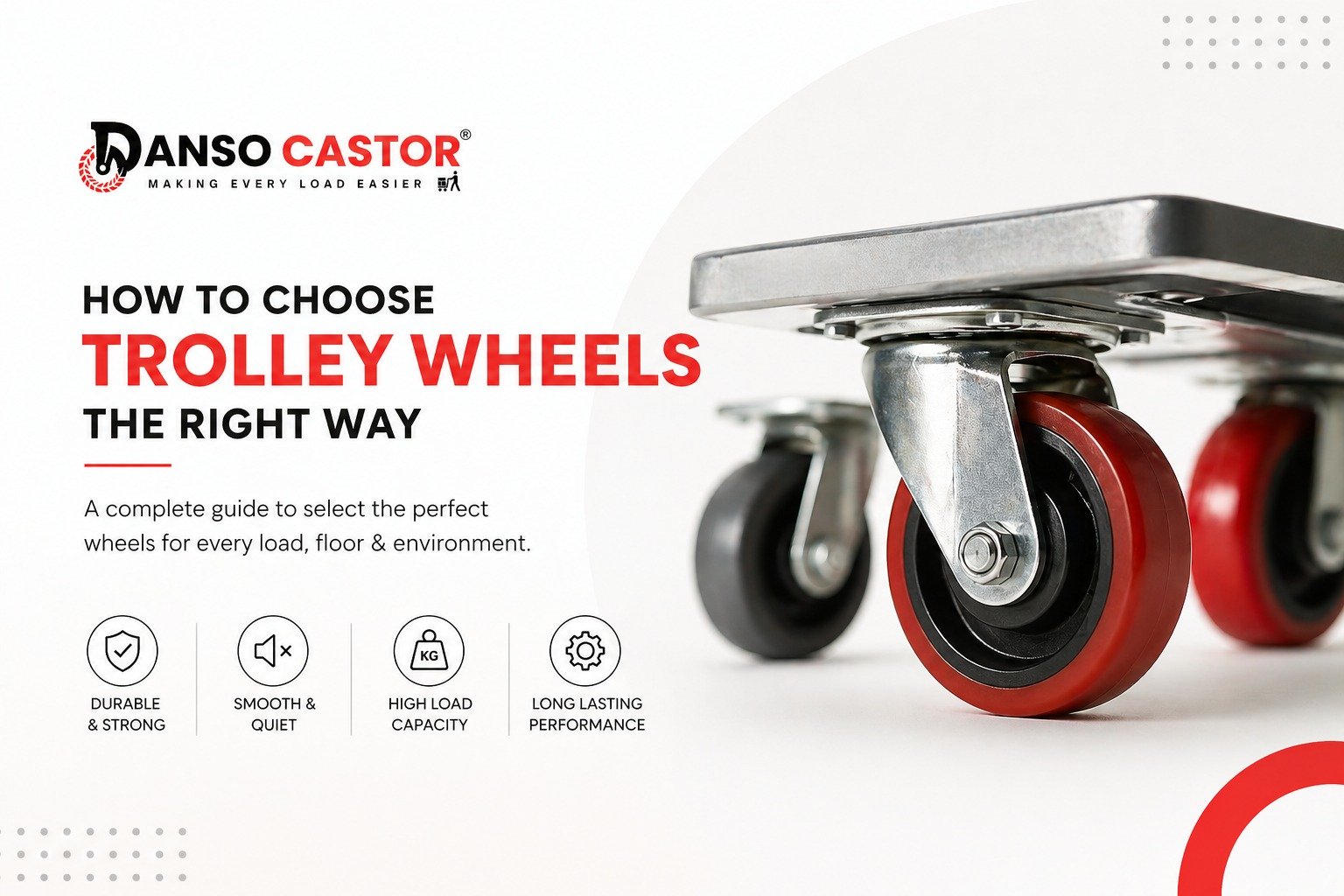
How to Choose Caster Wheels for Trolleys
The complete step-by-step guide to selecting the right trolley wheels for any industry
By Danso Castors | 2025 Edition
Most people pick trolley wheels the wrong way.
They look at price, pick the cheapest option, and move on. Then three months later the wheels crack, the trolley wobbles, the floor gets scratched --- and they're back to square one spending more than they would have if they'd just chosen right the first time.
Choosing the right trolley wheels isn't complicated. But it does require asking a few specific questions before you buy. This guide walks you through every factor that matters --- load, floor, environment, movement --- so you can make a decision that actually lasts.
Primary keyword covered in this guide: trolley wheels. Let's get into it.
Why the Right Trolley Wheel Choice Matters
A trolley wheel is not just a wheel. It's a load-bearing, floor-touching, environment-surviving component that your entire material movement depends on. Get it right and you'll forget it exists. Get it wrong and you'll be reminded of it every single shift.
| Wrong trolley wheel causes... | Right trolley wheel gives you... |
|---|---|
| Scratched or damaged floors | Floor protection that lasts years |
| Wheel cracking or seizure | Smooth operation every shift |
| Worker fatigue from hard pushing | Less effort, less strain on workers |
| Equipment breakdowns mid-operation | Reliable performance you can count on |
| Expensive early replacements | Long lifespan = lower total cost |
6 Factors That Determine the Right Trolley Wheel
Before we get into wheel types, understand these six factors. Every trolley wheel decision starts and ends here.
Total Load Weight — The Starting Point of Everything
Your trolley wheel must handle more than just the load it carries today. Always calculate the maximum possible weight — including the trolley itself — and then add a 30% safety buffer on top. A wheel rated exactly at your load weight will fail faster than one with headroom. For example, if your trolley carries 600 kg, you need wheels rated for at least 780 kg total (or 195 kg per wheel on a 4-wheel trolley).
Pro Tip: Split total weight by number of wheels, then multiply by 1.3. That's your per-wheel minimum rating. Never round down.
Floor Surface — The Factor Most People Ignore
Hard floors like epoxy, tile, marble, or concrete need soft wheels — polyurethane or rubber. Soft wheels don't crack hard surfaces and absorb vibration. Rough floors, gravel, or outdoor terrain need harder wheels — nylon or pneumatic. Putting hard wheels on a polished floor will scratch it. Putting soft wheels on rough outdoor terrain will tear them apart within weeks.
Pro Tip: Visit the area where the trolley will actually operate. Look at the floor. That one observation will tell you more than any spec sheet.
Movement Pattern — Straight Line or All Directions?
If your trolley moves in a straight line — along a corridor, a conveyor, a loading bay — rigid wheels are sufficient and often preferred for stability. If your trolley needs to turn, rotate, navigate around shelves, or move in any direction on demand, you need swivel wheels. Many trolleys use a combination: two fixed wheels at the back for direction control, two swivel wheels at the front for turning.
Pro Tip: Map out the actual movement path of the trolley before selecting wheel type. Don't assume — trace the route.
Working Environment — Temperature, Chemicals, Moisture
Environment dictates material. A rubber wheel in a chemical plant will degrade in months. A standard steel wheel in a food processing unit will rust and contaminate product. Match the wheel material to what it will actually be exposed to: high heat needs cast iron or high-temp nylon, wet environments need stainless steel or sealed bearings, chemical exposure needs chemical-resistant polyurethane or nylon.
Pro Tip: List every environmental condition the trolley faces — not just the most obvious one. It's often the secondary condition (like cleaning chemicals used on the floor) that destroys the wrong wheel first.
Speed of Operation — How Fast Will the Trolley Move?
Trolley wheels used in high-speed environments — distribution centres, automotive lines, fast-moving warehouses — need precision bearings and wheels built for speed. Wheels used in slow, occasional-push settings can use simpler bearing setups. Speed also affects noise. High-speed hard wheels on hard floors create noise levels that impact worker comfort and productivity over a full shift.
Pro Tip: If the trolley is being pushed at a jogging pace or faster, specify precision ball-bearing wheels. It's worth the cost.
Frequency of Use — Daily Continuous vs Occasional
A trolley used 8 hours a day, every day, in a factory needs a completely different wheel spec than one used twice a week in a storage room. Continuous-use wheels need sealed bearings, higher load ratings, and materials built for wear. Occasional-use trolleys can use lighter, simpler wheel setups without sacrificing reliability.
Pro Tip: Always specify the shift length and days per week when asking for wheel recommendations. This single detail changes the entire spec.
Trolley Wheel Types — Which One Fits Your Application?
Now that you understand what to look for, here's how each trolley wheel type performs across those factors:
| Wheel Type | Max Load (set of 4) | Best Floor Surface | Avoid When... |
|---|---|---|---|
| Polyurethane (PU) | Up to 2,000 kg | Smooth, tiled, epoxy floors | Extreme heat or heavy chemical exposure |
| Rubber | Up to 1,000 kg | Polished, slippery, or sensitive floors | Heavy loads, chemical exposure |
| Nylon | Up to 1,500 kg | Rough, uneven, or outdoor surfaces | Polished floors — will scratch them |
| Stainless Steel | Up to 2,500 kg | Wet, sterile, or washdown areas | Environments where noise is a concern |
| Cast Iron | Up to 5,000 kg | Industrial rough floors, high heat zones | Polished floors or low-noise environments |
| Pneumatic | Up to 1,200 kg | Outdoor, gravel, uneven terrain | Heavy factory loads or sharp surfaces |
| Forged Steel | 10,000 kg+ | Heavy industrial, concrete, steel floors | Any floor that can be damaged by hard contact |
Matching Trolley Type to the Right Wheel
Different trolleys have different demands. Here's a quick breakdown by trolley category:
Platform Trolleys
Used in warehouses, factories, and logistics for moving large, flat loads. These need high load-rated polyurethane or nylon wheels. Swivel-front, rigid-back configuration works best for control. PU wheels are the default choice for indoor platform trolleys due to their floor-friendliness and load capacity.
Hospital / Medical Trolleys
Used in hospitals, clinics, and labs. Absolute priority is quiet operation and easy steering. Rubber or PU wheels with sealed bearings are standard. Stainless steel frames paired with PU wheels handle sterile environments. Swivel wheels on all four corners for maximum maneuverability in tight corridors.
Industrial Shop Floor Trolleys
High-frequency use in manufacturing environments. These trolleys take punishment daily. Heavy-duty PU or nylon wheels with precision bearings are the go-to. If the trolley operates near furnaces or heat sources, cast iron or high-temp nylon is essential. Load ratings should be calculated conservatively.
Food and Pharma Trolleys
Hygiene is non-negotiable. Stainless steel wheels with sealed bearings are standard. PU wheels that meet food-grade material standards are also acceptable. Both must survive high-pressure water washdowns without corroding, seizing, or contaminating product. No exposed iron or standard steel.
Outdoor / Construction Trolleys
Moving over gravel, dirt, uneven ground, or construction sites. Pneumatic wheels are the top choice for shock absorption and comfort. For heavier outdoor loads, large-diameter nylon or solid rubber wheels hold up well. Sealed bearings are critical — dirt and debris kill open bearings fast outdoors.
Supermarket and Retail Trolleys
Light loads, polished floors, constant turning. Rubber or PU swivel wheels on all four corners for easy navigation. Noise is a concern in retail — rubber wheels keep things quiet. Wheel diameter should be large enough to roll over floor joints and small obstacles without jarring.
5 Common Mistakes When Choosing Trolley Wheels
These mistakes account for the majority of premature trolley wheel failures across Indian industries:
Fix: Calculate total cost of ownership — a cheap wheel that fails in 3 months costs more than a quality wheel that lasts 3 years.
Fix: Always check the floor surface first. A wheel rated for your load but wrong for your floor will damage both the floor and itself.
Fix: Indoor PU wheels on outdoor rough terrain will tear. Outdoor nylon wheels on indoor polished floors will scratch. Always separate the specs.
Fix: Always include the trolley frame weight in your load calculation. Trolleys can weigh 20-80 kg themselves — this matters at the margins.
Fix: Slow-use trolleys can use plain bearings. Fast or frequent-use trolleys need precision ball bearings. Wrong bearing choice causes early seizure.
Your Pre-Purchase Trolley Wheel Checklist
Before placing any trolley wheel order, run through this checklist. Every point must be answered:
- What is the maximum total load the trolley will carry (including trolley weight)?
- What is the floor surface — smooth, rough, wet, outdoor?
- Does the trolley need to turn or just move in a straight line?
- What is the operating environment — temperature, chemicals, moisture, hygiene?
- How fast will the trolley be pushed or pulled?
- How many hours per day / days per week will it be in use?
- Is floor noise or wheel noise a concern in this environment?
- Are there braking or locking requirements on the wheels?
Need Help Choosing? Talk to Danso Castors
Danso Castors — Trolley Wheels for Every Industry
Picking the right trolley wheel gets easier when you have the right supplier. Danso Castors works across industries — from hospital trolleys and food processing lines to heavy automotive shop floors and outdoor construction sites. They stock the full range and have a team that actually understands the application, not just the catalogue.
What sets Danso apart:
- Application-specific guidance — they help you choose, not just sell
- Full range of trolley wheel types — PU, rubber, nylon, SS, cast iron, ESD and more
- Custom wheel and caster solutions for non-standard requirements
- Pan-India supply with consistent quality across batches
Get in touch or browse the full range: www.dansocastors.com
FAQs — Trolley Wheels
Q: How many wheels does a trolley need?
Most trolleys use 4 wheels. For very long or heavy trolleys, 6 or 8 wheels distribute the load more evenly and reduce stress per wheel. As a rule: the longer or heavier the trolley, the more wheels you should consider.
Q: Should all four trolley wheels be swivel or just two?
It depends on how the trolley is used. Four swivel wheels give maximum maneuverability but can drift without direction control. The most common configuration is two swivel wheels at the front and two rigid wheels at the back — this gives both turning ability and stable straight-line movement.
Q: Do trolley wheels need brakes?
Yes, in most industrial and medical settings. Braking wheels (also called locking casters) prevent the trolley from rolling when stationary — critical in loading bays, slopes, hospital wards, and anywhere the trolley must stay put while being loaded or unloaded. Typically, 2 out of 4 wheels have brakes.
Q: What diameter trolley wheel do I need?
Larger diameter wheels roll over floor obstacles more easily and require less pushing effort. For smooth floors, 75-100mm diameter is standard. For rough surfaces or heavy loads, 125-150mm or larger is recommended. Bigger wheels also last longer under continuous use because load is distributed over more surface area.
Q: How do I know when trolley wheels need replacing?
Look for: visible flat spots on the wheel surface, uneven rolling or wobbling, excessive noise during movement, visible cracks or chips in the wheel material, or wheel seizure where the bearing no longer rotates freely. Don't wait until complete failure — proactive replacement avoids operational downtime.
Q: Can I use the same trolley wheels for indoor and outdoor use?
Generally not recommended. Indoor wheels are optimised for smooth floors and would wear rapidly on outdoor terrain. Outdoor wheels like pneumatic or large nylon wheels would scratch or damage indoor floors. If a trolley genuinely moves between both environments, pneumatic wheels with a large diameter are the closest compromise — but always verify with your supplier.
Final Takeaway
Choosing the right trolley wheels comes down to six things: load weight, floor type, movement pattern, operating environment, speed, and frequency of use. Work through each one systematically and the right wheel will become obvious.
Don't buy on price. Don't guess on load. Don't assume one wheel fits all your trolleys. Treat each trolley as a separate decision based on its specific job.
And when you're ready to source — whether it's standard trolley wheels or something completely custom for a unique application — Danso Castors is worth a conversation before you order anywhere else.
www.dansocastors.com — Trolley wheels for every industry, every floor, every load.
Back to All Blogs