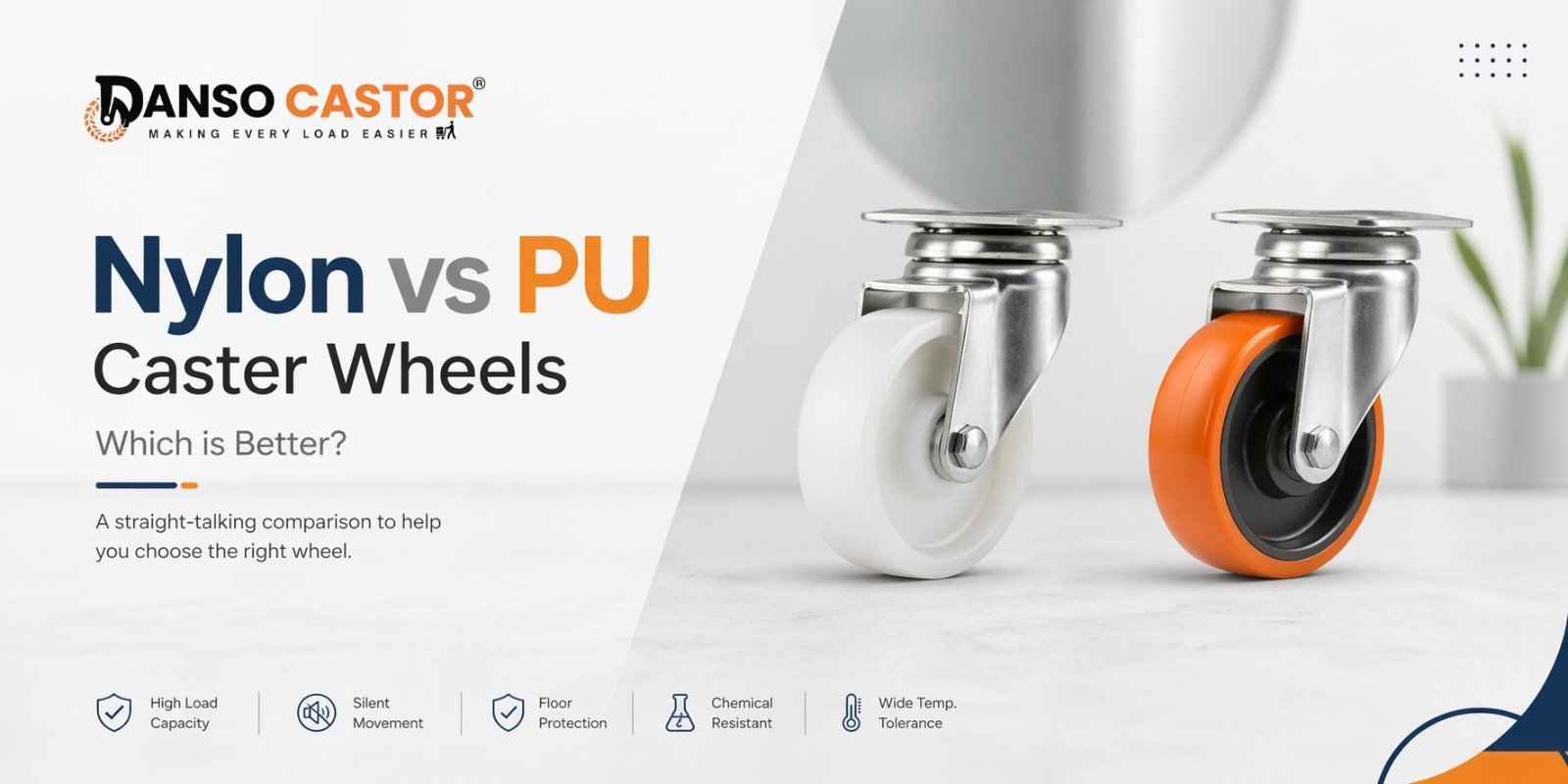
Nylon vs PU Caster Wheels
A straight-talking, side-by-side comparison to help you choose the right wheel for your industry.
When it comes to picking the right caster wheel for your trolleys, equipment, or industrial setup, two options come up again and again — nylon vs PU caster wheels. Both are popular, both handle decent loads, and both have their fans. But they are very different in how they perform in the real world.
This guide cuts through the confusion. By the end, you'll know exactly which wheel fits your environment — and why. At Danso Castors, we manufacture both, so this comparison comes from actual production and field experience, not guesswork.
What Are Nylon and PU Caster Wheels?
Nylon Caster Wheels
Made from engineering-grade nylon polymer
PU Caster Wheels
Made from polyurethane elastomer
Nylon wheels are hard, rigid, and extremely strong. They're lightweight for their load rating, resist most chemicals and moisture, and roll smoothly on clean, flat surfaces. A long-standing industrial staple.
Polyurethane (PU) wheels combine the rigidity of plastic with the flexibility of rubber. They're quieter, gentler on floors, and offer better grip — making them ideal for environments where noise and floor damage matter.
Head-to-Head Breakdown — Nylon vs PU Caster Wheels
Let's go through the key performance areas one by one. No fluff — just what actually matters on the floor.
1. Load Capacity
Excellent load capacity. Nylon is rigid and doesn't deform, making it reliable for consistently heavy or static loads in factories and industrial environments.
Good load capacity with slight flex under pressure. PU handles moderate to high loads well, but nylon edges ahead for extreme or sustained loads at the top end.
For maximum load capacity, especially in heavy industrial use — nylon takes this round.
2. Floor Protection
Hard and rigid — nylon can mark, scratch, or dent softer flooring like epoxy, tiles, or polished concrete over time. Fine for rough concrete but not ideal for finished floors.
PU's softer surface distributes load more evenly and rolls without scratching or leaving marks. It's the go-to choice for finished, tiled, or expensive flooring environments.
If your floors are finished, tiled, or expensive — PU caster wheels protect them far better than nylon.
3. Noise Level
Noticeably louder. The hard nylon surface creates clattering and rolling noise, especially on uneven or jointed floors. In open factories this isn't a big issue — in quieter settings, it can be.
Significantly quieter. PU absorbs vibration and rolls silently. For office environments, hospitals, retail, or any noise-sensitive setting — PU is the clear choice.
Noise-sensitive environments — hospitals, offices, retail — should always specify PU caster wheels.
4. Chemical & Moisture Resistance
Excellent resistance to oils, solvents, and most industrial chemicals. Also handles moisture well without swelling. A strong performer in chemical-heavy or wet environments.
Good general resistance, but PU can degrade when exposed to strong acids, ketones, or prolonged moisture. Not recommended for heavy chemical processing environments.
In chemical plants, food processing units, or wet environments — nylon's resistance is hard to beat.
5. Grip & Traction
Lower grip due to the hard surface. Rolls freely but may skid on wet or oily floors. Best suited to flat, dry, smooth surfaces where traction is less critical.
Superior grip and traction. PU's semi-flexible surface conforms slightly to the floor, reducing slipping and giving better steering control — especially valuable when moving heavy loads around corners.
Better grip means better control and fewer accidents. PU wins on traction, especially on corners and ramps.
6. Temperature Tolerance
Handles a wider temperature range, including higher heat environments. Stable performance between -40°C to +120°C. A strong performer in hot factory or foundry settings.
Performs well in normal to moderately warm environments, roughly -20°C to +80°C. Not suitable for very high-heat settings — PU can soften and deform under sustained high temperatures.
For foundries, heat-treatment areas, or outdoor summer environments — nylon handles heat far better.
Full Comparison at a Glance — Nylon vs PU Caster Wheels
| Criteria | Nylon | PU | Winner |
|---|---|---|---|
| Load Capacity | Very High | High | Nylon |
| Floor Protection | Low | Excellent | PU |
| Noise Level | Loud | Silent | PU |
| Chemical Resistance | Excellent | Moderate | Nylon |
| Grip & Traction | Moderate | Excellent | PU |
| Temperature Tolerance | High (up to 120°C) | Moderate (up to 80°C) | Nylon |
| Cost | Lower | Slightly Higher | Nylon |
| Lifespan | Very Long | Long | Nylon |
| Best For | Industrial, Heavy | Retail, Quiet, Floors | Tie |
Which Wheel to Choose — Use Case Guide
Still not sure? Here's a straight answer based on your environment.
Factory / Manufacturing
Recommended: Nylon — Heavy loads, rough concrete, high heat — nylon is built for this.
Warehouse / Logistics
Recommended: Nylon — High load, long distances on flat floors — nylon rolls freely and lasts long.
Hospital / Healthcare
Recommended: PU — Silent rolling, floor protection, hygiene — PU checks every box.
Retail / Shopping
Recommended: PU — Finished floors, quiet environment, good traction — PU is ideal.
Pharmaceutical / Lab
Recommended: Nylon — Chemical resistance and hygiene-friendly surface — nylon wins here.
Office / Co-working
Recommended: PU — Carpet or tiled floors, noise sensitivity — PU is the right call.
Food Processing
Recommended: Nylon — Moisture exposure, washdown environments — nylon handles it better.
E-commerce Fulfilment
Recommended: PU — Mixed floor types, moderate loads, frequent movement — PU balances all needs.
Outdoor / Loading Dock
Recommended: Nylon — Rougher terrain and exposure — nylon's hardness handles this well.
Hospitality / Hotels
Recommended: PU — Aesthetics, noise, floor safety — PU is the professional choice.
Common Mistakes When Choosing Between Nylon and PU Caster Wheels
- Choosing nylon for finished floors — The hard surface can scratch, mark, or indent epoxy, polished concrete, or tiled floors under heavy load. Always use PU for finished surfaces.
- Choosing PU for high-heat environments — PU can soften and deform when exposed to sustained high temperatures. In foundries or heat-processing areas, nylon is the correct choice.
- Ignoring noise requirements — If your facility has noise regulations or operates near staff-heavy areas, specifying nylon without considering sound levels can create daily frustration and compliance issues.
- Overlooking chemical compatibility — In food, pharmaceutical, or chemical processing — always check wheel material against the specific chemicals present in your environment before ordering.
- Buying on price alone — Nylon is typically cheaper upfront, but if it's the wrong wheel for your environment, replacement and floor repair costs will far exceed any initial savings.
Get Both — From Danso Castors
At Danso Castors, we manufacture both nylon and PU caster wheels in-house at our facility in Kadipur Industrial Area, Gurgaon. This means you get:
In-House Manufacturing
No middlemen. Direct from factory to you — better prices, faster delivery, and consistent quality every order.
Custom Sizes & Bulk Orders
Need a specific diameter, load rating, or mounting type? We handle custom orders for both nylon and PU wheels.
30+ Years of Experience
Since 1995, we've been supplying industries across Gurgaon, Delhi NCR, and pan-India with wheels that actually perform.
Expert Guidance
Not sure which wheel is right for you? Call us. We'll help you choose correctly the first time — no overselling.
The Final Verdict
The nylon vs PU caster wheels debate doesn't have one universal winner — it depends entirely on your specific environment and requirements. Here's the short version:
Choose NYLON if you need...
Heavy loads • Chemical resistance • High heat tolerance • Low cost • Long lifespan in tough, open environments
Choose PU if you need...
Floor protection • Quiet rolling • Better grip • Finished or tiled surfaces • Noise-sensitive or customer-facing spaces
Still Not Sure? Ask the Experts.
At Danso Castors, we've been matching wheels to environments since 1995. Tell us your use case and we'll recommend the right caster — nylon, PU, or something else entirely from our full product range.
No generic answers. Just the right wheel for your specific situation.
Custom sizes, swivel & fixed options, and bulk orders available. Get in touch to discuss your requirements.
Back to All Blogs